American Aviation Historical Society
MEMBERS SHOULD LOG IN FIRST TO ACCESS FULL ARTICLES
|
September 2014 |
|
|||||||||||||||||||||||
|
MARK YOU CALENDARS!AAHS ANNUAL GATHERINGSATURDAY, FEBRUARY 7, 2015Historic Flabob Airport
| ||||||||||||||||||||||||
|
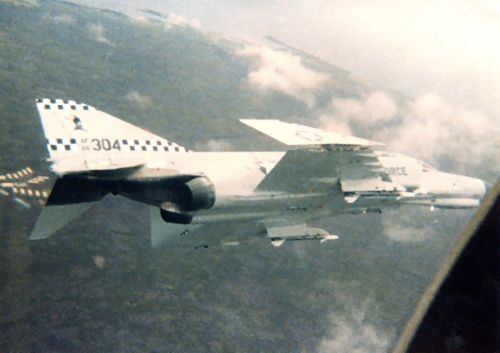
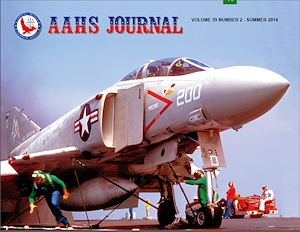
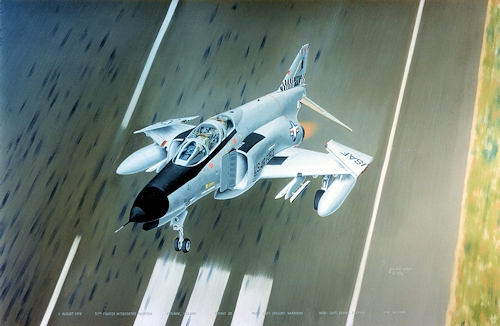
Flight of an F-4E with Wings Folded
August 1, 1978, I was almost halfway through my oneyear
tour with the 57th Fighter Interceptor Squadron
"Black Knights"� at Keflavik, Iceland, and, in spite of
the relatively dreadful climate, I was enjoying just about every
minute of it. I was an aircraft mechanic working on fighters,
serving a viable mission as we kept watch on Soviet aerial
activity in the Greenland-Iceland-United Kingdom (GIUK)
Gap. It was a far cry from my first assignment fresh from
technical training school, where I was assigned to a small fleet
of North American T-39 Sabreliners in Colorado Springs. Most
of my time there seemed to be spent cleaning, polishing, or
handling bags for a seemingly endless stream of high-ranking
officers and other dignitaries; needless to say, I became a bit
disillusioned. No doubt prompted by a lack of immaturity in
understanding that there was more to the Air Force than combat
aircraft, certain among my superiors felt I was developing an
attitude problem. My orders to Iceland – the third choice on
my "dream sheet"� – were tantamount to a Death Row inmate
receiving a pardon, for me. |
|
|||||||||||||||||||||||
|
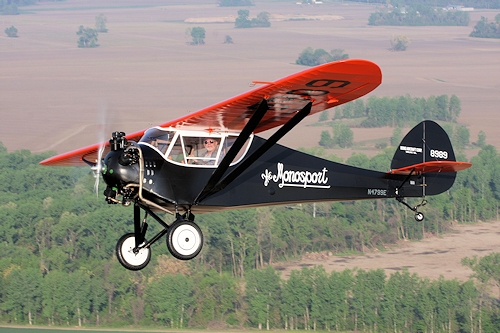
Of course, Bud Dake was certainly Mr. Monocoupe at our airport – having been totally impressed with Jim
Harvey’s Coupe that was in the hangar next door to Bud’s. So he started with a Luscombe 8A, rebuilt it, went to an 8F, rebuilt it, and finally, had the wherewithal to get his first Monocoupe. The quest for Monocoupes at Creve Coeur Airport became endemic – with John Haltermann, Frank Kerner, John Cournoyer and Mel McCollum getting their 90As soon after. Of course, it became a contest between Bud and John to see which "˜Coupe was the fastest, and after playing with rigging, drag reduction, and other means to make them go faster, John named his "Matchit"� – throwing down the gauntlet for all others. After Bud built his Clip Wing, with its 185-hp Warner, the race was over. And if that was not enough, he and Jim Younkin designed and built the Mullicoupes - which literally blew the doors off everything at the airport. Somewhere along the line, Bud decided that Monocoupes were not just about speed, and purchased a basket case Monosport,[1] with the idea of someday rebuilding this last remaining example into a flying aircraft. |
|
|||||||||||||||||||||||
|
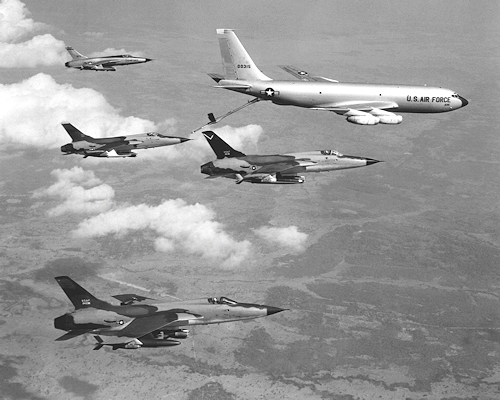
I had been flying Chinese Air Force (CAF) F-86s and F-84s on Taiwan for over two years when in 1958, I was assigned to the Strategic Air Command (SAC). Naturally, I was expecting Initially, I performed a number of tasks within SAC, such as Chief-of-Standardization for non-tactical aircraft, Flying Safety Officer, etc. This never deterred my desire to find a way to transfer back to a fighter aircraft unit. For this reason, I exerted no effort towards becoming a B-52 bomber or KC-135 tanker crew member. In fact, in 1962, I applied for the U-2 program, which at the time, was conducted at Laughlin AFB, Texas. After traveling to Laughlin for an interview, etc., I was told I should hear from them within two weeks. Following my return to Walker AFB, N.M., my wife informed me that my name was on the list to attend Air Command and Staff College (ACSC), Maxwell AFB, Alabama. Unfortunately or fortunately, I don’t know which; ACSC had preference over the U-2 assignment. In 1964, following my graduation from ACSC, I was assigned to the 821st Strategic Airspace Division, Ellsworth AFB, South Dakota. On September 17, 1964, I became a member of the 28 Air Refueling Squadron. Usually, SAC tanker crew members received their training at Castle AFB, Calif., or Walker AFB, N.M., but for whatever reason, I did not. Instead, I was checked out in the KC-135A by Ellsworth AFB, 28 ARS personnel. A tanker crew consisted of a pilot (aircraft commander), copilot, navigator, and boom operator. Getting qualified in the aircraft was easy; becoming adjusted to the SAC culture was a little more difficult. It was not too long, however, before I became accustomed to the operational routine of a SAC KC-135 crew member. I understood the purpose of the seven-day-on and seven-day-off alert system but I never learned to like it. Minimum Interval Take-Off (MITO) scrambles, which were initiated by someone at SAC Headquarters, Offut AFB, Neb., were always an interesting experience. It seemed like the individual who initiated the MITO scrambles would usually wait until Ellsworth AFB was . . . |
|
|||||||||||||||||||||||
|
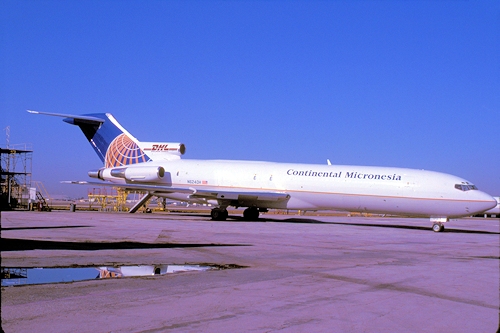
The exotic 3,000 islands of Micronesia are formed by the Mariana, Caroline and Marshall Island groupings. Their total land mass is not equal to Rhode Island but these tiny specks in vast Pacific cover more than three million square miles. The word Micronesia comes from the Greek, Mikros (small) and Nesos (Island) and the name was proposed by Domeny de Rienzi to the Societe de Geographie de Paris in 1831. To most people these are places seen in travel brochures as representing some form of paradise that they will never visit, with exotic names going east to west from Hawaii that include Majuro, Kwajalein, Ponape (now more commonly spelled Pohnpei), Truk (now spelled Chuuk meaning mountain), Guam and to the south Yap and Palau and then north to Rota and Saipan. Made infamous during the terrible battles of WWII these islands were devoid of dependable air service until the introduction of Continental Airlines Air Micronesia in 1968 and the improvement in the islands’ landing facilities. Prior to the advent of Air Micronesia there had been one enterprise establishing air service in the region created by Orvis Nelson and his Transocean Airlines with headquarters on Guam. Under the supervision of the Department of the Interior, Transocean won the contract to begin service in Micronesia with Consolidated PBY-5A amphibians that were leased from the U.S. Navy and being used for the inter-island flights. Transocean operated the aerial service from July 1, 1951, until it went bankrupt on July 11, 1960. The carrier became embroiled in legal issues that were thrust upon non-scheduled airlines and its failure to obtain permission to provide full transpacific service finally caused it to cease operations. Following the demise of Transocean, Juan Trippe’s Pan American World Airways was requested to take on the responsibilities formerly provided by Transocean. Pan American, which was already serving Guam, began where Transocean left off with DC-4 equipment and Grumman Albatross amphibians .[See Appendix 1] For seven years, Pan Am valiantly attempted to provide suitable and reliable air service by flying unpressurized Douglas DC-4s and Grumman SA-16 Albatross amphibians mainly to Ponape. With constant breakdowns, poor facilities, very expensive supply and maintenance costs as well as poor service with passengers sitting on canvas seats and served cold box lunches leading to islanders complaining about the carrier, the venture was not successful. In the late 1960s, the Department of the Interior invited bids from airlines that wished to serve the area and received responses from Pan American, Northwest Orient Airlines and Hawaiian Airlines with the latter carrier being the most logical choice given its proximity to Micronesia. Eventually a bid was forthcoming from Continental Airlines that possessed the least experience in flying commercial flights across the Pacific although the airline was involved in military charter flights and some operations in Southeast Asia. The president of Continental Airlines, Robert Forman Six won the certification battle. The subsidiary of the then home-based Denver carrier would be known as Air Micronesia and was incorporated in the state of Nevada in 1967. In the formation of Air Micronesia the key to a profitable air service began with the creation of the United Micronesia Development Association (UMDA) of which Continental Airlines wouldl . . .
|
|
|||||||||||||||||||||||
|
EARLY STEAM ENGINE ATTEMPTS FOR AIRCRAFT
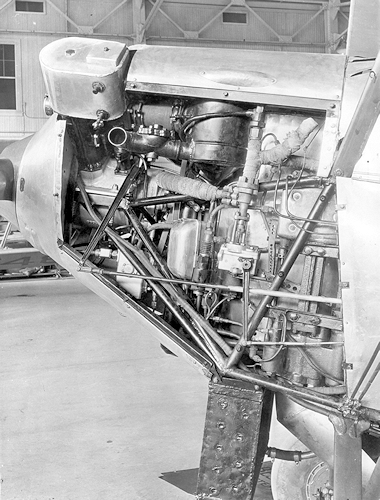
Developers of the 1933 Steam-Driven Airplane were born in Princeton, New Jersey. Their father was chairman of the board of the Central Railroad of New Jersey. George Besler was a former geologist and 31 years of age, and his brother William a mechanical engineer 29 years of age. William graduated from Princeton University in 1926 and was already a licensed pilot. At age 21 he built a steam locomotive for the New Haven Railroad that went a million miles without a breakdown. The Beslers acquired the assets of the Doble Steam Car Co,, located in San Francisco and Emeryville. California. This was the beginning of the company known as Besler Systems of Emeryville, California. They went on to design and manufacture devices to lay down a smoke screen, used by both the Army and Navy during WWII, and after the war marketed them as spraying units for insecticides, In 1955, William commissioned the design of a folded wing plane and flew it at the Oakland Airport. They designed truck air brakes that are still in use today, but sold the patents for someone else to manufacture. They also made and sold a small high-pressure steam engine that would go from a cold start to full power in two minutes. In 1970, William conducted lengthy experiments for General Motors and he put a steam engine in a Chevrolet that got 10 miles per gallon of water, and a top speed of 58 mph. He pronounced it was unreliable, inefficient, and hard to maintain . . . |
|
|||||||||||||||||||||||
|
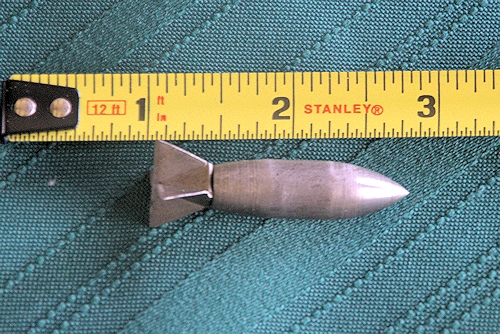
During the period 1955 through 1960, I was assigned to USAF Section, Military Advisory Assistance Group (MAAG) Taipei, in support of the Republic of China Air Force (ROCAF). My assignment covered two Wings of F-86F Sabres at Hsinchu and Tao Yuan AFB. In April 1958, a serious concern was being experienced on the potential invasion of Taiwan by the Chinese communists as a result of the Kinmen/Matsu Island crisis which precipitated a Chinese communist buildup to invading Taiwan. Col. W. Riggs, Hsinchu AFB Team Chief with USAF-MAAG, suggested using a “flechette” weapon against communist troops that were expected to be storming ashore during the invasion. Riggs recalled that the flechettes had seen limited use in the Korean War (thus the ready supply?). The flechette proposed for use were miniature, razor-sharp, bomb-shaped projectiles that were available in the USAF inventory. The concept was proposed to Gen. W. Dean, Commander USAFMAAG, who gave his authorization to proceed with design of a carrier to be used on the F-86F. Sgt. David Reese, Sgt. W. Jones and I decided to use a 200-gallon fuel drop tank as the carrier/dispenser. It was modified to provide three compartments, each carrying approximately 2,500 flechettes. Three filler doors were installed at the tank top and three explosive bolt release doors were fitted to the tank bottom. Using existing five-inch high-velocity aerial rocket pigtail wiring in the aircraft underwing allowed the rocket intervolometer located on the pilot’s left hand console to be employed as the release mechanism for deployment. The modifications took about two weeks to accomplish with most of the effort going into the explosive bolt and release . . . |
|
|||||||||||||||||||||||
|
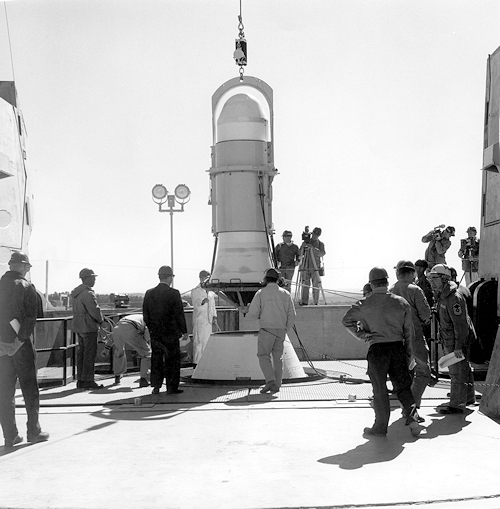
Introduction Unfortunately, these criteria ignore airborne vehicles that have neither wings nor propellers or air-breathing engines. But these aerial vehicles also have contributed greatly to the advancement of aviation. And, depending on their appellation, they may be major instruments of scientific exploration or mass destruction. The former are called spacecraft, the latter are known as missiles. Preface The postwar rocket-propelled vehicles had mixed and diverse purposes. They varied from satellite-bearing launch vehicles, to Intermediate Range Ballistic Missiles (IRBMs), to the larger and long-range Intercontinental Ballistic Missiles (ICBMs). The popular ICBMs during the 1950s were the R&D Atlas and Titan missiles. Their early successes or failures at Cape Canaveral were viewed with interest on the evening news. Their failures were often due to powerplant problems or errant guidance systems. Whatever the cause, their finale was often a conflagration of flame and thunderous eruption of missile debris. The TITAN I Missile The Titan I missile was stored in a hardened 160-foot deep underground concrete silo and raised on an elevator to the surface for launch. An Exciting Challenge As a young aeronautical engineer with two years experience at McDonnell Aircraft Co. in St. Louis, this fledgling missile technology sounded exciting. The interest in missiles . . . |
|
|||||||||||||||||||||||
|
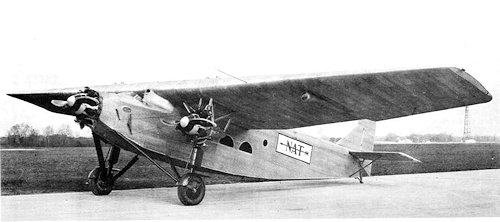
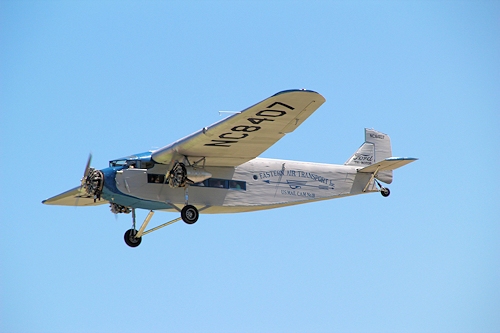
Who Designed the Ford Trimotor #1, Designing the Ford Trimotor
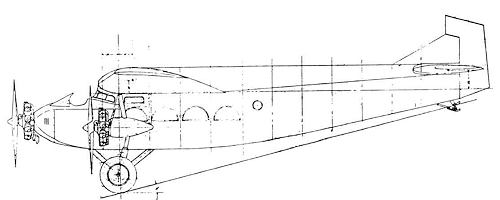
“For years we have heard and read statements saying William B. Stout designed the Ford Trimotor. In June 1953 there was a sevenpage article in Popular Mechanics called “Those Fabulous Flying Fords,” as usual naming him the designer. It was then that I felt this myth had gone too far for me to keep silent any longer. I immediately wrote a letter to the editor of Popular Mechanics describing how I designed the Ford Trimotor, affectionately called the “Tin Goose.” The managing editor wrote to Mr. Stout explaining the confusion resulting from my letter, and requested a reply from him. I understand this started quite a furor behind the scenes. As far as I know, he left the matter as ambiguous as ever. But he never said he did design it!” The above is the introductory paragraph of a talk presented with slides, and tape recorded, at the Third Northeast Aero Historians meeting, of which the American Aviation Historical Society was one of the sponsors, held at the Van Curler Hotel, Schenectady, New York, on October 27-29, 1967. The address was given by Mr. Tom Towle, entitled “Designing the Ford
Trimotor.” The career of Tom Towle literally spans the age of powered flight, since his inspiration and interest in aircraft began almost with the dawn of the age, from seeing the Wright Brothers fly
their airplane in the fields near Dayton in 1904. He was born close to the shop of the Wright Bicycle Co. and used to take his bicycle there to have it fixed by Wilbur or Orville or Charles
Taylor. Mr. Towle graduated from Yale University in 1920 with an M.E. degree and, by early 1921, was working at the Dayton-Wright Airplane Co., then headed by Orville Wright, E.A. Deeds, Charles Kettering and H.E. Talbot, beginning in stress analysts under Kenneth Lane. Over the next several years he put in brief stints at McCook Field, and at Glenn L, Martin Co. and Aeromarine Plane& Motor Co. as the contracts for airplanes favored one company and then another. In 1924 he joined the Stout Metal Airplane Co. In the following pages he describes, in his own words, his connection with the famous Ford Trimotor and how the design A contemporary account, from another participant on the Ford scene at the same time, Mr. John G. Lee, is presented as the second half of this review of “Who Designed the Ford Trimotor?” It is interesting to note that the areas of close agreement provide a highly colorful description of Mr. Henry Ford and his operations in this era just preceding the great boom in air travel that was to be opened by the Ford Trimotor and other great transport airplanes. As Mr. John G. Lee has pointed out in the accompanying article, a successful enterprise is a desirable connection, and a third party who claimed considerable responsibility for the success of the Ford Trimotor design was Mr, Harold Hicks. We do not have direct testimony from Mr. Hicks, but his claims were set forth in an article in the Dearborn Historical Quarterly.[1] That the Ford Trimotor had great impact on the growth of air transport is indisputable. In the period from 1926 to 1934 the Trimotor became the mainstay of a number of American airlines
whose descendants are in existence today. After that, the “Tin Goose” became the most ubiquitous of all - it established a legend only surmounted by its replacement, the “Gooneybird.” Ford Trimotor is still synonymous through the world with nostalgia.[2] It is apparent that no one person could have been entirely responsible for the development of the Ford Trimotor. But this inside story, from two great men who were there and can. . . |
|
|||||||||||||||||||||||
|
Who Designed the Ford Trimotor #2, Early Days of the Ford Trimotor
When the transcript of the talk by Mr. Towle became available, it was shown to Mr. John G. Lee, who had had a part in the engineering of the Ford Trimotor in the same period. He had stayed on at the Ford Motor Co. until the end of 1926, and was engaged in redesign work on the wing, and in cleaning up some of the design of the Trimotor as it went into production. Of Mr. Towle’s account he said, “It is a fascinating story, (but) there is a fair amount of which is not known to Mr. Towle. With your permission I would like to take a little time for this, as I think it is important to get the record straight. The old Trimotor was a turning point in American aviation. The skill, the luck, and the mistakes of its designers, and above all the extraordinary methods of the Ford Motor Co. at that time represent a fascinating relationship. I’ll . . . try to As a result the following article by Mr. Lee arrived: Whenever a project or device is notably successful, everyone connected with it likes to take credit for being its originator. The Ford Trimotor was no exception. Usually credited to William B. Stout, who was certainly the initial driving force, it was generally assumed that others were also involved, for neither Mr. Stout nor the Ford organization ever produced another really successful airplane. I have before me the brief paper by Tom Towle entitled“Designing the Ford Trimotor,” which was originally given as a talk, and tape recorded. In this paper Mr. Towle takes much of the credit for designing the Ford Trimotor. Since I was employed by Mr. Stout and the Ford Motor Co. and assigned to the Trimotor, I was much interested in Mr. Towle’s account. However, I was also greatly distressed; for while many of the things Mr. Towle mentioned fitted with my memory very well, there were others that seemed not to fit at all. Finally I came to realize that many of the discrepancies between Mr. Towle’s account and my recollections might be explained by the peculiar organization of the Ford Motor Company. This
organization in the 1924-27 period was still a monolithic dictatorship, with Henry Ford at the top. Only two other men were ever mentioned; one was Henry’s son Edsel, who was vice president, and the other was William B. Mayo, chief engineer. Nobody else in the company had a title. As in any other dictatorship there were cliques and factions. Whichever clique had the confidence of the boss was in control. So there was constant jockeying for power, no end of secrecy, spying and power politics, all the way from the top to the humblest draftsman. One’s future might depend upon which clique had access to Mr. Ford at any given time. However, if one’s work was outstanding, and the project itself of importance, one might be courted by several different cliques or their sub-groups, and this was also a tricky business. It happened that Tom Towle and I, through circumstances beyond our control, were usually in different cliques. So we often saw the same events very differently. One thing I think we can agree on is who the principal individuals that played key roles in the actual design of the Ford Trimotor. Aside from Mr. Ford, I believe there were five. They were William B. Stout, George Prudden, Tom Towle, Maj. R.W. Schroeder, and myself. There were others, such as Mayo, Koppen, McDonnell, Hicks, and Karcher, to name a few, who certainly contributed, but they were not key figures for any appreciable time during the critical months when the airplane was designed and put into production. Perhaps, before we try to assign credit amongst these key men, it may be enlightening to try to catch the flavor of those early days, the habits of mind and custom that then controlled the Ford Motor Co. and all connected with it. So I have written the events as I remember them, helped in many places by Mr. Towle’s paper. Professor Koppen was also kind enough . . . |
|
|||||||||||||||||||||||
|
Early Flight Testing at Patuxent River Naval Air Station Introduction But six months later, Marines at Midway learned the bitter urgency of needing better aircraft, not just Navy cast-offs. They were all in this together. The fundamental skills it took to stunt in an airplane Des learned at Pensacola. But the raw nerve it took to push his aircraft to its limits and beyond, were basic to Bombing Squadron One and soon Flight Test. In less than seven years, Des went from flying biplanes to being the first Marine Corps aviator to fly both the jet and helicopter. Friends who had attended my parents’ wedding, were lost at isolated mosquito-infested sand-spits in the Pacific, an irreplaceable loss and a huge score to settle as quickly as possible. The only question was how. On April 1, 1943, a short commissioning ceremony inaugurated the Naval Air Test Center, the coalescing of the various specialized and heretofore scattered Naval aviation testing units. Having a single but sparsely populated location for such varied testing as dive-bombing, catapulting and carrier tactics without worrying about the proximity to the nation’s capital city was a vast improvement. Adm. John McCain set the tone as the Chief of the Bureau of Aeronautics, and Cmdr. “Ras” Rassieur spoke briefly that April morning saying how very honored he was to assume command of the post, which he had been shepherding since the previous September. It had taken a year since the ground breaking in April 1942 to construct from agricultural estates, wetlands and duck blinds a half-dozen huge concrete hangars, pave several runways, ramps, taxiways and access roads. In an inconceivable environmental assault that could never occur in the United States today, the land of St. Mary’s County was
converted almost overnight for the sole purpose of helping create the toughest and smartest naval aviation force in the world, to defeat all comers. For months before and after the dedication, pilots from Anacostia and Quantico easily got their bearings by the dust plume that rose well into the atmosphere, . . . |
|
|||||||||||||||||||||||
|
The FORUM is presented as an opportunity for each member to participate in the Journal by submitting interesting or unusual photographs. Negatives, blackand-white or color photos with good contrast may be used if they have smooth surfaces. Send submissions to the Editorial Committee marked “Forum of Flight,” P.O. Box 3023, Huntington Beach, CA 92605-3023. Mark any material to be returned: “Return to (your name and complete address).” Please include as much information as possible about the photo such as: date, place, names, etc., plus proper credit (it may be part of your collection but taken by another photographer) |
|
|||||||||||||||||||||||
|
    The President's Message contains the Society's management perspective on the current status of the Society was well as directions and initiatives that the organization is pursuing. |
|